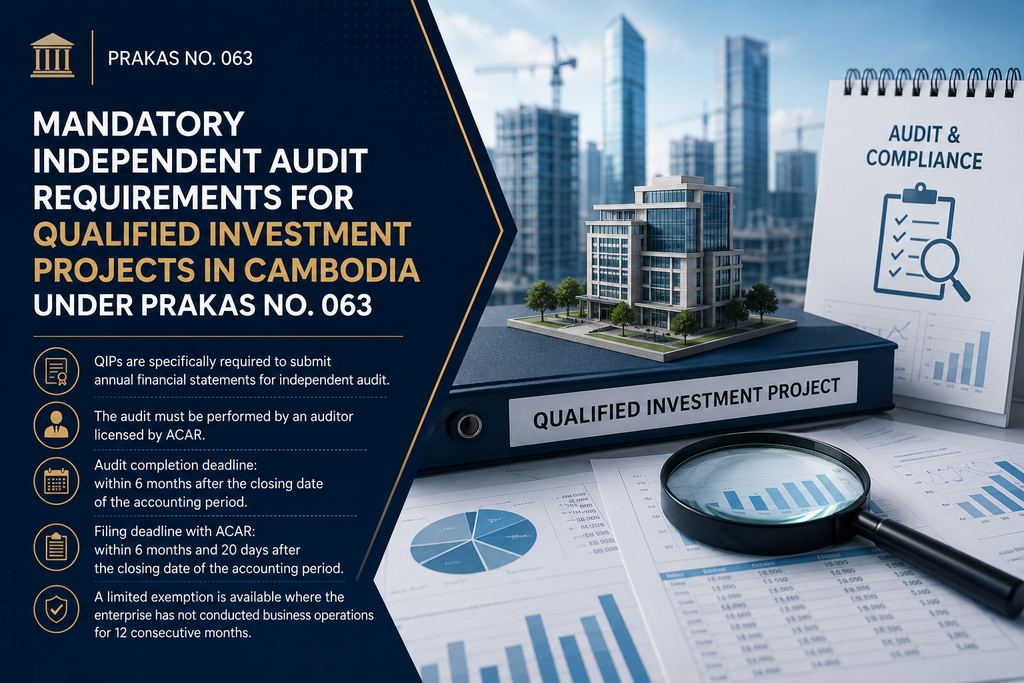
Cambodia’s revised statutory audit framework expressly requires Qualified Investment Projects (“QIPs”) to submit their annual financial statements for independent audit.
Under Prakas No. 063 dated 18 August 2026 on the Obligations to File Annual Financial Statements and Submit Financial Statements for Independent Audit, QIPs are specifically identified as a category of enterprise subject to mandatory independent audit.
The revised requirement applies from the 2026 accounting period onwards.
What Is a Qualified Investment Project?
For purposes of Prakas No. 063, a Qualified Investment Project refers to an enterprise that has received a registration certificate from:
- the Council for the Development of Cambodia (“CDC”); or
- the Capital or Provincial Investment Subcommittee.
This definition is important because the audit obligation under the Prakas is tied to the enterprise’s QIP status.
QIPs Are Specifically Subject to Mandatory Independent Audit
Article 8 of Prakas No. 063 provides that enterprises falling within specified categories must submit their annual financial statements for independent audit.
One of those categories is:
Qualified investment projects.
Accordingly, a QIP does not need to satisfy the general two-out-of-three financial criteria under Article 9 in order for the Article 8 audit requirement to apply.
The audit obligation arises because the enterprise is a QIP within the meaning of the Prakas.
No Separate QIP Turnover Threshold Is Prescribed in Article 8
Unlike the general audit test under Article 9, Article 8 does not prescribe a specific turnover, asset or employee threshold for QIPs.
Therefore, once an enterprise falls within the definition of a QIP under Prakas No. 063, the mandatory independent audit requirement applies by virtue of that status.
The general Article 9 thresholds—covering turnover, total assets and employee numbers—constitute a separate audit test applicable to enterprises outside or in addition to the specific categories identified in Article 8.
Who Can Perform the Independent Audit?
Prakas No. 063 defines an “independent audit” as an audit of financial statements performed by an auditor licensed by the Accounting and Auditing Regulator (“ACAR”).
A QIP should therefore ensure that its statutory audit is performed by an appropriately licensed auditor.
Audit Completion Deadline
The independent audit work and issuance of the independent auditor’s opinion must be completed:
No later than six months after the closing date of the accounting period.
Where the audit cannot be completed within the prescribed period, the enterprise may apply to ACAR for an extension by stating appropriate reasons.
For example, where a QIP has a financial year ending 31 December 2026, the independent audit would ordinarily need to be completed by 30 June 2027, unless an extension is obtained in accordance with the applicable requirements.
Filing Audited Financial Statements with ACAR
A QIP subject to independent audit must file:
- its audited annual financial statements; and
- the independent auditor’s report
with ACAR no later than:
Six months and twenty days after the closing date of the accounting period.
Accordingly, for a QIP with a 31 December 2026 year-end, the filing deadline would ordinarily be 20 July 2027.
The filing must be made in accordance with the forms and procedures prescribed by ACAR.
Is an Audit Exemption Available?
Prakas No. 063 provides a limited exemption mechanism for enterprises falling within Article 8, which includes QIPs.
An Article 8 enterprise may apply to ACAR for exemption from the independent audit requirement where it has not conducted business operations for twelve consecutive months following the most recently audited financial year.
The exemption is not automatic.
An eligible enterprise must:
- submit an application to ACAR no later than 30 days after the closing date of the accounting period; and
- pay the applicable public service fee in accordance with the regulations in force.
A QIP that has suspended or ceased operations should therefore not assume that its audit obligation automatically ends.
Effective from the 2026 Accounting Period
Article 26 of Prakas No. 063 provides that enterprises required to submit financial statements for independent audit under Articles 8 to 11 must comply with the revised requirements:
From the 2026 accounting period onwards.
Prakas No. 563 MEF.PrK dated 10 July 2020 has been repealed, while existing implementing guidelines issued under that Prakas remain effective until replaced by new implementing guidelines.
Key Takeaway for Qualified Investment Projects
For the 2026 accounting period onwards, an enterprise holding QIP status as defined under Prakas No. 063 is expressly subject to mandatory independent audit.
The obligation arises from the enterprise’s status as a QIP and does not depend on satisfying the general turnover, asset or employee thresholds under Article 9.
Management of a QIP should therefore ensure that:
- annual financial statements are prepared on a timely basis;
- the statutory audit is performed by an auditor licensed by ACAR;
- the audit and auditor’s opinion are completed within six months after the accounting-period closing date; and
- the audited financial statements and independent auditor’s report are filed with ACAR within six months and twenty days after the closing date.
Early planning is particularly important for QIPs to ensure timely compliance with the statutory audit and filing requirements.
Download the Prakas here:
Legal Reference: Prakas No. 063 dated 18 August 2026 on the Obligations to File Annual Financial Statements and Submit Financial Statements for Independent Audit.
Disclaimer: This article provides general information based on Prakas No. 063 and does not constitute legal, accounting or other professional advice. The application of the requirements should be considered based on the particular facts and circumstances of the enterprise together with applicable Cambodian laws, regulations and ACAR implementing guidance.